
St Paul’s Net Zero Support Group
On Wednesday 29 March 2023, the Lenten reading groups held a combined meeting to consider how St Paul’s will become Net Zero by 2030, which in broad terms means cutting greenhouse gas emissions to as close to zero as possible within 7 years. Becoming Net Zero by 2030 is also a goal of the Perth Anglican Diocese, with implications for all its parishes and agencies. The meeting was well attended and featured an inspiring presentation by Peter Newman and a thoughtful and wide-ranging discussion. At the end of the meeting, six parishioners formed the St Paul’s Net Zero Support Group to guide our parish towards its goal.
The Beacon is the group that arose out of our Advent study to guide St Paul’s to a sustainable future: to reach Net Zero by 2030 and “strive to safeguard the integrity of creation and sustain and renew the life of the earth” (Anglican 5th Mark of Mission)
We are beginning projects that involve us individually, as a church, a community and globally. As part of our work, we’ll use this space to celebrate wins, share information, suggestions and business recommendations.
We have adopted the Bioregional One Planet Living Framework. Talk to Annolies Truman or any other Beacon members if you want to join us on our exciting journey.
We celebrate a win: Val has solar panels! Yay! Here’s to lower bills…and one more step to New Zero! Anyone with a commitment to Net Zero and interested in attending bi-monthly 1-hour meetings is very welcome to join us.
Humanities Professoriate Lecture
Prof. Peter Newman
Thanks to the many who came to my Professoriate Lecture ‘Can we dare to hope?’. For those who wanted to see the lecture the link is here
I also attach the first video of our Trackless Tram at City of Stirling. The Symposium we are helping to deliver can be followed up on Click here to view our video
You will notice from my lecture that I am struggling to find some hope in the present situation where the gas industry (especially LNG) is suggesting they can grow for the next 50 odd years and yet the IEA/IPCC are saying they cannot grow but must decline. What then can places do that make LNG like WA and the Middle East? Last Thursday we had a chance to pursue this issue when 120 people came to Politics in the Pub at the Local Hotel in Fremantle. The topic was COP28 which is to be in Dubai where this issue will be central to the agenda. It was a special night and the following link gives you a taste: Click here for more details about COP 28
The paper I refer to is now out in Green Issue Click here to view Green Issue:
Hope some of this can be useful.
THE BEACON
31 December 2023 – Saving Water
Australian households held the worst record for water consumption. On average, each Australian uses 341,000 litres of water each year – that’s around 8 backyard swimming pools. We are the most carefree water users on the planet, and we live on the driest continent on the planet!
What can we do?
- Make sure we only water gardens on watering days ..and turn off if it’s raining.
- Make sure we’ve got a full load of laundry before we hit the ‘start’ button on the washing machine. Likewise the dishwasher.
- Fix any dripping taps or leaky toilets. A leaking tap can waste as much as 20,000 litres of water a year.
- Buy efficient appliances. New appliances such as washing machines and dishwashers have water ratings labels on them that tell we how much water they use.
- If it’s yellow let it mellow, if it’s brown flush it down – with a half flush.
- While we’re being short but sweet, take shorter showers. And turn off the tap while our brushing our teeth.
- Catch water in a bucket in the shower while we’re waiting for the water to get hot• Insulate hot water pipes. This avoids wasting water while waiting for hot water to flow through and saves energ
- Older style toilets use around 18 litres of water per flush! The latest ultra-low-flush toilets can use as little as 4.5 litres for a full flush and 3 litres for a half flush.
- Keep a container of water in the fridge so that we won’t need to run the water down the sink until it’s cool enough to drink.
- Washing fruit and vegies in a half-filled sink instead of under running water is a great way to cut back on water wastage.
- Try to use phosphate-free, eco-friendly detergents and cleaning products – there’s a great range to choose from these days and they’re much better for our environment.
- Use water tanks to catch rainfall. Currently most of rain just gets washed down the drain.
- Whether we use the simple ‘bucket’ method to collect greywater, or have a complete greywater system installed, reusing this valuable resource can greatly reduce our water use.
- Encourage your friends and neighbours to be part of a water-conscious community. Promote water conservation in community newsletters, on bulletin boards and by example – Water Fact Sheet Cool Australia
THE BEACON
24 December 2023 – The Bible and the Earth
Genesis 1: 26
God spoke: “Let us make human beings in our image, make them reflecting our nature
So they can be responsible for the fish in the sea,
the birds in the air, the cattle,
And, yes, Earth itself, and every animal that moves on the face of Earth.”
Jeremiah 2:7
“I brought you to a garden land
where you could eat lush fruit.
But you barged in and polluted my land,
trashed and defiled my dear land.
Job 12:7-10
“But ask the animals what they think—let them teach you;
let the birds tell you what’s going on.
Put your ear to the earth—learn the basics.
Listen—the fish in the ocean will tell you their stories.
Isn’t it clear that they all know and agree that God is sovereign, that he holds all things in his hand—
Every living soul, yes, every breathing creature?”
We do not own the earth, we are stewards of it, caring for it for our generation and the generations to come. We can each do this in our own small way.
Remember, our children sing this and so can we:
“This little light of mine, I’m goin’ to let it shine”
Quotations from The Message Bible.
THE BEACON
17 December 2023 – A Big Win to Stop Fracking in the Kimberley
… and more work to do
The expanded water trigger legislation has now passed both houses of parliament!
Our St Paul’s community, by taking action alongside Traditional Owners and local communities, has helped ensure all fracking proposals will be subject to federal assessment for their impact on water. This has positive implications for fracking projects in the Kimberley and NT, which, before December 7, could use millions of litres of groundwater and cause irrevocable damage to the water table, without their projects being assessed. This is truly a win to celebrate!
However, a cause for concern is that Woodside has been granted approval for seismic testing and drilling of up to 10 wells for its$16.5bn Scarborough gas development. This development is:
- the largest Australian oil and gas project in a decade
- estimated to cause up to 1.6bn tonnes of emissions over its lifetime
- situating gas wells along the WA coast in some of the world’s most biodiverse waters
- locking Australia into more fossil fuels as the rest of the world shifts to cleaner, cheaper renewable energy
- putting vulnerable marine species, like whales and turtles, at risk by dredging, drilling and seismic testing.
Even Twiggy Forrest had harsh words over this. Woodside, he said, has “an agenda to get carbon bombs going as quickly as possible”. To cap all this, last week Woodside and Santos announced a merger to create an even bigger fossil fuel corporation.
Go to www.greenpeace.org.au to sign the petition.
THE BEACON
10 December 2023 – Some More Ideas for Sustainability
Save energy with energy efficient lighting. Compact fluorescent bulbs use around 20% of the energy to produce the same amount of light as an incandescent bulb and can last up to 10 times as long.
Set up a water catchment system. A rain barrel can collect rainwater, which can be used to water plants or wash your car.
Switch to water-based paints when renovating. Oil paints have harmful chemicals that can leak into the watershed and pollute the waterways.
Use the dishwasher. Unintuitive though it may sound, dishwashers actually save water. A dishwasher uses 13 litres of water. Washing dishes by hand uses between 33 and 440 litres!
When using the dishwasher: Pre-rinsing is a thing of the past. And although most Australians do it, it’s time consuming and wasteful. It can waste up to 65L of water per washload. All you have to do is scrape the larger pieces into the trash and load your dishwasher.
If you buy water to drink, install a purifying tap filter, which will soon save money and prevent plastic bottles that end up in landfill.
Ditch the plastic straws. Plastic straws are among the top ten contributors to plastic marine debris around the world.
Use eco-friendly cleaning products. More sustainable home living means making sure our cleaners are clean in every way. Most surface disinfects use toxic chemicals that are slow to biodegrade, threaten wildlife, and are toxic to you.
Become a borrower. Renting and borrowing items instead of buying them can reduce the amount of personal items that end up in the landfill. With increasing numbers of toy libraries, tool libraries, and clothing rental services, this is easier than ever.
THE BEACON
3 December 2023 – Vegan for the Environment
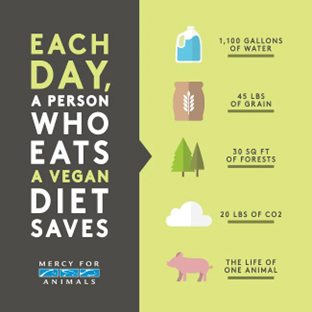
We are often told to ‘reduce, reuse, recycle’ or ‘conserve water’ or change to solar power. And all these things are excellent for our planet, of course, BUT the single biggest way to make a positive impact on this world is to change our diets to one that is plant based.
Plant based, or vegan, diets have a hugely beneficial impact on the environment.
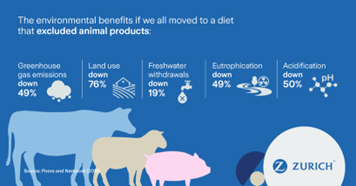
We are often told to ‘reduce, reuse, recycle’ or ‘conserve water’ or change to solar power. And all these things are excellent for our planet, of course, BUT the single biggest way to make a positive impact on this world is to change our diets to one that is plant based.
Plant based, or vegan, diets have a hugely beneficial impact on the environment.
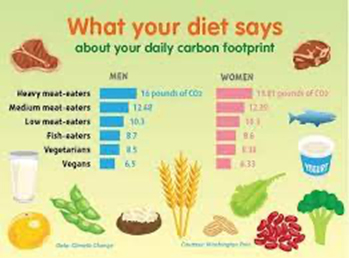
Diets that include meat and dairy products contribute to one-third of all global emissions (methane from livestock, mostly). Vegan diets produce 93% less methane and vegans are responsible for 75 percent less in greenhouse gases than meat-eaters:
Currently, 68 per cent of farmland is used for livestock. Planting a fifth of this with crops would produce the same amount of food as all the animals. This would leave 26 million square kilometres spare – an area 1.5 times the size of Russia – that could be planted with meadow or forest, to improve biodiversity.
Some people think ‘I could never go without bacon!’ or ‘vegan cheese tastes so bad!’ But how about introducing one or two vegan days a week – or switching to plant-based milk instead of cow’s milk? You could switch beef mince to plant based in your recipes or try a vegan diet for advent, or lent.
It doesn’t need to be all or nothing – every little change makes a tiny difference.
Give it a go!
THE BEACON
26 November 2023 – Have a Net Zero Christmas
Maybe we know our loved ones desperately need something that we can give them for Christmas; that will be wonderful! Otherwise, why not reduce the enormous waste and offer sustainable items and not things to shove in a drawer? Think about how we can provide presents from the heart that will thrill them, but also be gifts for the good health of the planet. Here are some suggestions; we can imagine many more.
- Create
- Design cards
- Paint or draw a picture
- Write a poem or story
- Make up a song and sing or play it with friends
- Produce a sculpture
- Snap a photo and share it
- Perform a dance
- Act out a play with family members
- Crochet, knit or sew something needed
- Provide an IOU for something they need
- Gardening
- Preparing a meal
- Babysitting
- Painting a room
- Provide consumables
- Make (or buy) homemade jam, preserves or pickles
- Prepare (or buy) homemade cakes, biscuits, bars
- Cook a meal
- Sew handkerchiefs or masks
Buy activities, performances or lessons (as long as we’re sure they’ll like it…especially if we can come too!)
- Museum
- Zoo
- Drama
- Music
- Sport
- Wrap gifts in
- Paper saved from last year
- Paper illustrated by the kids
- Tea-towels
Buy gifts that give to someone in need:
- IGWR (that’s In Giving We Receive in Nepal) – Redirect your birthday and Christmas gift lists to the kids in Nepal. It’s also a great way to share the whole idea that generosity creates a better tomorrow.” Sponsor children’s futures
- Really Useful Gifts Tear Fund – Buy a goat, chickens or teacher training
- Oxfam Unwrapped – Help transform the lives of people living in poverty.
Reminder
OzHarvest developed a world-first product, Use It Up Tape! The tape can be used to mark a shelf in your fridge or pantry, or on food items/containers that needs using up. It’s a visual reminder for the whole household – once you can see it, you can use it up! The Beacon Group have purchased a small number of these ‘Use it up’ tapes which are available to purchase for $1 each, these will be available at morning tea on Sunday.
THE BEACON
15 November 2023 – What Effect Does Food Waste Have?
Australian Waste Facts
- We waste 7.6 million tonnes of food each year, 70% of this is perfectly edible
- Food waste costs our economy $36.6 billion a year
- Majority of food waste in Australia comes from our homes (2.5 million tonnes)
- Food waste costs households $2,000 – $2,500 per year
- More than 25 million hectares of land is wasted to grow food that is not eaten
- The top 5 most wasted foods in Australia are vegetables, bread, fruit, bagged salad &
- leftovers
- Over 2 million households in Australia went hungry in the last 12 months due to lack of
- funds, sometimes skipping meals or going whole days without eating
- Demand for food relief is higher than ever. The charities OzHarvest support, reported a 61%
- increase in demand in the last 6 months.
- 54% of food insecure households have someone in paid work.
- 1.3 million children lived in food insecure households in the last year
- On a typical day, 306,000 households are receiving assistance from food relief organisations.
But the good news is, reducing food waste is the most effective thing individuals can do to address climate change. OzHarvest developed a world-first product, Use It Up Tape! The tape can be used to mark a shelf in your fridge or pantry, or on food items/containers that needs using up. It’s a visual reminder for the whole household – once you can see it, you can use it up! Recipes to help ‘Use it up’ can be obtained HERE
The Beacon Group have purchased a small number of these ‘Use it up’ tapes which are available to purchase for $1 each, if you are interested please speak to a member of the group, proceeds of all sales will be donated to St. Paul’s.
THE BEACON
Beacon Corner: 15 November 2023 – What the Digital World Costs
The ‘dematerialised’ digital world absorbs 10 per cent of the world’s electricity and represents nearly 4 per cent of the planet’s carbon dioxide emissions.
- If digital technology were a country, it would be the third-highest consumer of electricity behind China and the United States.
- An email with a large attachment consumes as much energy as a lightbulb left on for one hour.
Streaming produces 300 million metric tons of CO2 each year. - One Google search uses as much electricity as a lightbulb left on for up to two minutes.
Data Centres account for about one percent of global electricity use
Things You Can Do to Reduce Your Carbon Use on the Web
- Reduce your time online.
- Use energy efficient devices…use computer on solar power rather than phones
- Choose WIFI over mobile data
- Send texts instead of email
- Send only essential emails.
- Send links to a document rather than attach it
- Delete emails you don’t need
- Shut down tabs and windows you’re not using.
- Use ad blockers.
- Turn off ad tracking
- Delete apps you’re not using
- Turn off video in Zoom meeting when not contributing
- Unsubscribe from marketing emails you don’t use
- Turn off automatic video and audio players on websites
- Reduce streaming consumption.
- Download things from the cloud onto hard drives
- Download videos and audio files you want to use again
- Turn off computers when you’re not using them.
- Recycle electronic equipment
The Dark Cloud: how the digital world is costing the earth – Guillaume Pitron (trans. Bianca Jacobsohn)
International Energy Agency
How to Reduce Your Digital Carbon Footprint
THE BEACON
Beacon Corner: 5 November 2023 – Trackless Trams by Prof Peter Newman
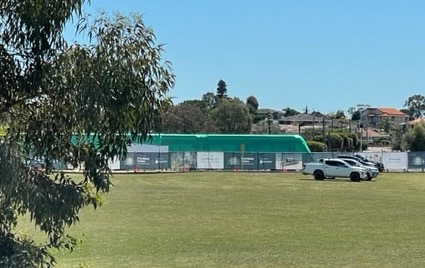
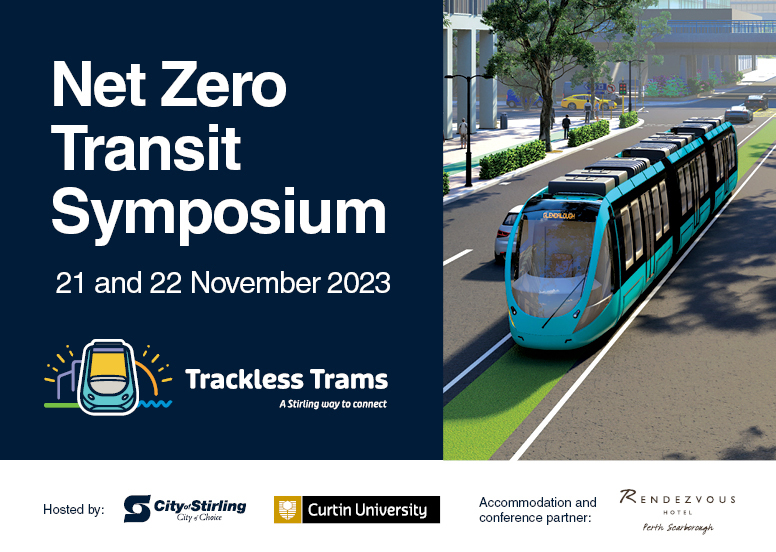
This picture shows a new kind of public transport being commissioned in the City of Stirling Car Park. It is the only one of its kind outside China. It’s a Trackless Tram.
WHAT ARE TRACKLESS TRAMS?
- They are not a bus, they are more like a smart phone was to a landline.
- They have been created in China from 6 innovations in high-speed rail that has transformed a road-based vehicle into a rail-like vehicle similar to the latest light rail/tram systems.
- It is electric but has no overhead wires, instead it has either Lithium Ion Batteries, Capacitors or Hydrogen Fuel Cells that can be recharged at stations and in depots over night.
- It is electronically guided so it has a digital track – either with magnetic markers in the road or using LIDAR (Light Detection And Ranging) supported by video, GPS (Global Positioning Satellites) and Radar. This makes a very smooth ride quality like a train as the road ahead is detected and signals sent to the wheels to adjust their positioning.
- It can carry the equivalent of 6 lanes of traffic using a normal three-cat tram.
- It is much cheaper than light rail and can be installed without disrupting the economy along a corridor. Fremantle has a corridor mapped out from Murdoch to the Fremantle Station.
- It has special stations every 500m or so that they can become recharge hubs for all EVs in the area, especially electric bikes and scooters.
- Walkable station precincts with dense housing, shops and offices are likely to be attractive to private development as the land value will be significantly improved. Such station precincts are planned down South Street.
- These precincts can be net zero demonstration precincts using solar and batteries similar to the WGV development in White Gum Valley.
- The opportunity to build such corridors down main roads can spread across the city reducing traffic and also reducing urban sprawl.
Two videos made by World Economic Forum describe our work at Curtin: VIEW HERE and HERE
People are coming from across the world to attend our Symposium on November 21 and 22 with an open day for the public at City of Stirling car park on 26th November: Read Trackless Tram Business Case City of Stirling
THE BEACON
Beacon Corner: 29 October 2023 – Fighting Giants Screening
Free Freo screening of Fighting Giants, 2 November at 7 pm in Sullivan Hall
The Kimberley region in northern WA has some of the largest intact natural landscapes in the world. It is a culturally rich region, home to a living Aboriginal culture that is many tens of thousands of years old, where many Traditional Owners have a deep connection to Country.
But fracking companies are the closest they’ve ever been to turning the region into an industrial wasteland. Frack Free WA has collaborated with Kimberley Traditional Owners, climate scientists and economists from The Australia Institute to produce this new film.
‘Fighting Giants’ is a rallying call to defend so many things that West Australians value: the stunning Kimberley landscapes, our fragile climate, and Aboriginal culture and land.
At this community screening of the short but powerful film, the Frack Free Kimberley team will talk about ways you can get involved. You’ll have the opportunity to write a short, impactful letter to a key state government politician, expressing your concerns about fracking.
This event is open to everyone, so bring a friend or get a group together for a night of inspiration, motivation and community grassroots change.
The next meeting of The Beacon is Sunday October 29 after Mass and morning tea in the Meeting Room. Come along and be part of the solution!
THE BEACON
Beacon Corner: 22 October 2023 – Sustainable Lifestyle
- Spend more time outside.
- Walk or take public transport
- Eat more whole foods. Better yet, go vegan!
- Plant your own herbs and vegetables
- Become a member of your local food co-op.
- Plant a tree with someone.
- Borrow books from the library instead of purchasing them directly.
- Read your favourite newspaper publications online instead of reading the paper versions.
- Regularly prepare home-cooked meals and save on takeaway storage containers.
- Adopt pets instead of buying them from a breeder. There are so many orphaned pets out there who need a family.
- Stop accepting disposable cutlery and napkins.
- Have a sniffle? Carry around your own handkerchief instead of using disposable tissues.
- Use stainless steel drink bottles.
- Drink water instead of bottled drinks
- Create a video, a slideshow or a blog post of how you implemented these ideas and publish them publicly.
Many more suggestions: 100+ Simple Tips To Live a More Sustainable Lifestyle
THE BEACON
Beacon Corner: 15 October 2023 – Fracking in the Kimberley
Fracking in the Kimberley Oil and gas companies are planning to frack the Kimberley region in northern WA, leaking toxic ‘forever’ chemicals into groundwater and releasing millions of tonnes of climate pollution every year.
WHAT’S AT RISK?
1. Climate: Pollution from exploiting the Kimberley’s oil and gas would be more than double the whole of Australia allowable CO2e emissions for energy under the Paris Agreement, with detrimental local and global impacts.
2. Environment: The National Heritage-listed Fitzroy River supports a huge array of wildlife including the critically endangered Freshwater Sawfish and 18 species of fish found nowhere else in the world. The eucalypt woodland and tall grassland that covers the region and most of northern Australia are the world’s most extensive intact tropical savannahs. The Kimberley coast and seas are recognised as being amongst the most intact marine areas in the world.
3. Culture: The region is home to a living Aboriginal culture that is many tens of thousands of years old. Traditional owners fear damage to country and culture from loss of water and sacred sites and need to have their voice respected.
4. Water use is expected to be 100 megalitres per well (over 40 Olympic-size swimming pools). Contamination of the water table by fracking is well documented.
5. Human Health: 33 of the chemicals used are considered highly toxic to human health, resulting in fracking bans in most of WA.
(Read The Risks of Oil and Gas Development for Human Health and Wellbeing: Implications for Australia)
WHAT CAN YOU DO?
1. Environment Minister Tanya Plibersek has promised to put stronger water protections in our environment laws, but not until next year, when the damage from fracking could have occurred.
Urge the Minister to introduce these protections now https://350.org.au/fix-our-climate-laws/
2. Sign the petition to stop fracking in the Kimberley https://www.lockthegate.org.au/kimberley_frack
3. Read about alternatives – A report has demonstrated that electricity generation in Broome can be achieved with over 80% renewable energy at three quarters of the price of gas-fired (LNG) generation, achieving total lifetime savings of $321m https://sen.asn.au/wp-content/uploads/BroomeCleanEnergyReport2023.pdf
4. RSVP to the free Fremantle community screening of ‘Fighting Giants’ on Thursday 2 November, 7:00 pm – 8:30 pm at Sullivan Hall in White Gum Valley.
THE BEACON
Beacon Corner: 8 October 2023 – Plant Natives in Our Gardens
Choose plants native to the area where you live, as they are adapted to the soil and the environment.
Native plants
- Survive on rainfall alone. Once established it’s actually best not to water unless the weather is really dry
- Provide habitat, shelter and food for local wildlife. Choose plants that attract birds, butterflies and bees, and provide shelter for small animals.
- Support a healthy environment. They do not need chemical fertilisers or pesticides as lawns and exotic plants do.
- Improve biodiversity which creates healthy ecosystems that clean the water, purify the air, maintain healthy soil, regulate the climate and provide us with food and resources.
- Help you save time and money. Exotic plants need lots of care, water, fertiliser. Plants that belong here need much less.
- Visit a community garden, like Nanine Common or
- Booyeembara Park
Remember
St Paul’s Garden Group is planting a native garden and parishioners can get on board by donating or joining in the planting – see Debbie Gwynne.
For help choosing plants for our area.
THE BEACON
Beacon Corner: 1 October 2023 – How to Compost
We have already shared ideas a few weeks ago about how we can improve our own Food Waste.
- We had a Worm Farm display
- We can compost our food waste
- We can have a worm farm, a compost bin, compost heap if your yard is big enough or share composting with neighbours
The science of composting is all about getting the carbon/nitrogen ratio of the contents correct. There are two broad categories that you can put in your compost bin or pile – green and brown. Generally 30 brown to 1 green.
Green materials include fruit and vegetable scraps, used tea, coffee grounds, crushed eggshells, grass clippings, green plant cuttings, old flowers and many weeds.
Brown materials are things like straw, paper and cardboard, dry leaves, woody prunings and sawdust (but not from treated wood). Don’t add meat, citrus, weeds with seeds, diseased plants, animal droppings. Add small pieces as large pieces take too long. Shred or cut vegetables into small pieces, crunch up egg shells.
Fremantle Council has Food Organics Garden Organics (FOGO) for some of the residents. Use this if you don’t have your own compost bin.
See:
THE BEACON
Beacon Corner: 25 September 2023 – Sustainable Gardens
- Compost the soil to retain carbon and grow plants, using a compost bin and worm farm.
- Use less water by planting native and climate appropriate vegetation.
- Collect and harness rainwater
- Plant vegetation to avoid erosion, and take up CO2.
- Avoid concrete or artificial grass.
- Plant vegetation that attracts bees, butterflies, cockatoos or other local wildlife
- Create a home garden with vegetables, herbs and fruit. Share with friends and neighbours.
- Use biochar, a stable form of carbon
- Use natural organic methods rather than chemical fertilisers
- Use integrated pest management techniques and companion planting
More ideas
- Sustainable Gardening Australia https://www.sgaonline.org.au
- Sustainable garden ideas – 28 ways to create an eco-friendly garden
THE BEACON
Beacon Corner: 17 September 2023 – Worm Farming
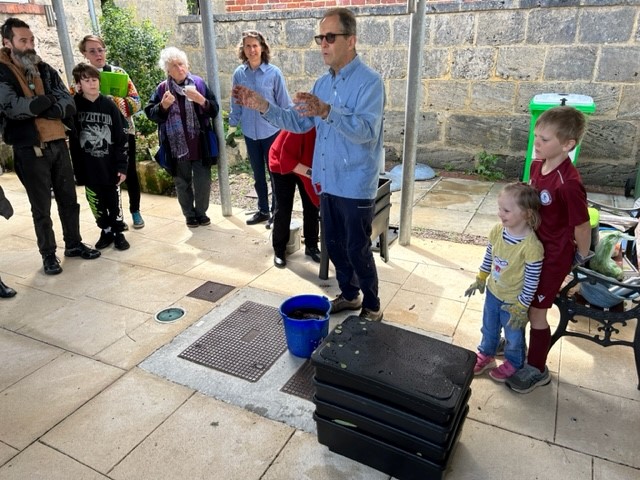
On Sunday September 3, Debbie, Annolies and Barry, ably supported by some enthusiastic children, demonstrated to interested parishioners how to establish and maintain a worm farm.
Together we set up 2 empty worm farms – one donated by Christabel and Linda for use at St Paul’s and one bought by the Meredith family for their personal use
How to establish a worm farm
Line the bottom section with paper. Add soaked bedding material for the worms, such as coconut peat (often provided with the worm farm).
Add a layer of composting earthworms to the bedding. Provide them
with limited food scraps to begin with, including crushed egg shells for
essential calcium, (as the worm consume these scraps, you can add
increasing amounts).
Add an insulation layer (the hessian that comes with the kit or a layer of damp newspaper). Place the lid on the box.
Simple worm farming tips:
- Feed worm small amounts of citrus, garlic, onion or chillis (too much makes the farm too acidic for the worms). The normal amount coming out of a family kitchen is just about right.
- Worms cope with cold weather better than hot weather. Shield them from the fierce summer sun in the shade of a tree, or on the south side of the house in the shade.
- Worms eat the equivalent of their own weight daily.
- When worms consume kitchen scraps, they convert them into nutrient-rich castings that are 10x more bio-available for plants.
- Worm farm café can be obtained from Bunnings for $99 and City of Fremantle will provide a $40 rebate. They also sell some worm farms at a discounted rat. Go to City of Fremantle website
THE BEACON
Beacon Corner: 10 September 2023 – Saving Water
Things you can do to save water:
- Shower for shorter time (uses less power as well)
- Make sure the washing machine and dishwasher are full before use ( (uses less power as well)
- Scrape off food rather than pre rinse before adding plates to the dishwasher
- Add only what you need to the kettle for hot drinks (uses less power as well)
- Put a plug in the sink rather than let the water run
- Wash vegetables in a bowl rather running water
- Use low flow shower heads and toilets
- Plant Australian native plants, including ground cover instead of lawn
- Water gardens only when needed….turn off automatic sprinklers when it’s been raining. Remember sprinkler ban June 1 to August 31I
- Make sure there are no leaks
- Install a rainwater tank for the garden or, to save more water, plumb it into the toilet
THE BEACON
Beacon Corner: 27 August 2023 – Carbon Footprint
Do you know how much you and your household impact our climate? Get out your receipts and see where you stand. Take a quiz to estimate it for you. Where can you improve?- Walk more?
- Eat less meat?
- Fill in gaps around windows and doors?
- Only boil just enough water?
- Use reverse cycle AC for heating instead of gas or electric radiators?
THE BEACON
Beacon Corner: 20 August 2023 – Net Zero for Clothing
The Australian Fashion Council reports that we discard 227,000 tonnes clothing to landfill: only 7,000 tonnes is recycled. 100,000 tonnes gets exported overseas! We need to:
- Buy clothing that is environmentally sourced.
- Buy organic clothing, not fossil fuel derived : Wool, cotton, linen, hemp, bamboo
- Buy only what we need. Will we use it 30 times?
- Repair rather than discard – Fremantle Repair Cafe:
- Use clothes swaps, hire or rent
- Buy second hand
- Remake and redesign clothing
- Give away clothing for re-use
- Fashion Impact on Climate Change Ecostyles
THE BEACON
Beacon Corner: 13 August 2023 – Net Zero and Sustainability Websites
Beacon Corner, 13 August
Have you been looking for more information about Net Zero and Sustainability? We have a Beacon Corner page linked to the St Paul’s website that has a lot to explore. Here are some other inspiring resources:
- War on Waste is a brilliant program screening Tuesdays 8.30pm on ABC and accessible on ABC iView War on Waste ABC
- Electrify Boroondara a broad alliance of community groups and individuals committed to accelerating our clean energy transition
- Electrify 2515 mission to create one of Australia’s first all electric communities in postcode 2515
- Totally Renewable Yackandanah goal of powering this small Victorian town with 100% renewable energy, giving resilience, savings, lower emissions and showing that it can be done
- My Efficient Electric Home Facebook group that helps householders make their home more sustainable.
- Getting off gas: why, how, and who should pay? Grattan Institute
THE BEACON
Beacon Corner: 6 August 2023 – Reduce Food Waste
Up to 10% of global greenhouse gases comes from food that is produced, but not eaten. We Australians waste 7.6 million tonnes of food each year, 70% of which is perfectly edible. Read more at OzHarvest Food Waste Facts.
Plan meals and shopping lists so we don’t buy more than we need.
Don’t buy extra economy size when the household is small. It’s false economy if the extra is wasted.
Store food correctly.
Make sure we use older food first. Cook up casseroles, soups or stews, which we can freeze for later or donate to others.
Learn to preserve food when we have extra: make jams and pickles, or use a dehydrator if you have one.
Share extra produce with neighbours and friends.
A compost bin or worm farm can take unavoidable food waste so we can reduce landfill while creating rich soil for your garden. Alternatively, use FOGO if your council provides it.
Twenty ways to reduce Food Waste
THE BEACON
Beacon Corner: 31 July 2023 – Cleaner Transport Options
What can we do to reduce fossil fuel emissions in our transport use?
- Use the car less
- Take public transport
- Ride a bike
- Walk
- Combine trips and errands
- Share rides with work mates or friends
- Use electric bikes and cars
- Take fewer plane trips.
Planes emit around 100 times more CO2 per hour than a shared bus or train ride, and the emissions of global aviation are around 1 billion tons of CO2 per year — more than the emissions of most countries, including Germany.
THE BEACON
Beacon Corner: 16 July 2023 – Dealing With Windows
After filling in the gaps around doors and windows and kitchen appliances, homeowners need to have a look at the heat gain and loss through windows. “Glazing – the glass and frames in windows, external doors and skylights – has a significant effect on thermal performance. Up to 40% of a home’s heating energy can be lost and up to 87% of its heat gained through windows.” Glazing Your Home
- What can we do to reduce heat transfer through our existing windows?
- Position outdoor blinds or eaves or plant trees to shade windows to keep out summer sun. It’s better to keep unwanted heat from entering at all.
- Add solar film tinting.
- Use close fitting tightly woven curtains with pelmets to keep air trapped.
- Use close fitting honeycomb blinds that trap the air.
- Replace window glass with low-E, or low-emissivity window glass, this works well for keeping heat out, but is less useful for letting in winter warmth.
- Replace existing windows with double glazed windows improving heat transfer, noise reduction and security. uPVC (un-plasticised Polyvinyl Chloride) or wood frames are best, though wood requires ongoing maintenance. Aluminium frames allow a lot of heat transfer unless properly thermally broken.
THE BEACON
Beacon Corner: 9 July 2023 – Fremantle, Trees and Climate Change
On July 1, 2023 a seminar was held at St Pauls titled Fremantle, Trees and Climate Change. Barry Healy, Environmental Activist and member of the Ecocare Commission gave the introduction and was the MC.
Jeremy Thomas, Senior Urban Forest Officer from the City of Fremantle gave a very interesting talk, informing the audience about the wide-ranging work he and his staff perform. He told us about the ongoing work in planting, maintaining verge trees and promoting tree canopy cover throughout Fremantle. Planting trees has to be done properly, making sure only roots but no trunk is buried. The emphasis was on planting healthy stock and then making sure the trees were cared for from first planting throughout their lives.
Peter Newman, Professor of Sustainability, Curtin University gave a presentation on the necessity of both trees and technology. A technology focus has to be used in conjunction and at the same time as a focus on trees, particularly on tree canopy cover.
Improvements in technology, like solar, batteries and electric vehicles as well as trackless trams, will reduce our carbon emissions. Better sustainable housing as in the White Gum Valley, sustainable whole villages like the Ecovillage in Witchcliffe, will contribute to the community’s movement towards Net Zero. The model that Plico is using, where people pay a monthly charge for solar panels and batteries so that not only they will benefit but the grouped power can help iron out the grid is really promising. The Co-op that you join in Plico also provides support for any issue over the technology and how to share best practice in our homes ; it has a charitable support side for local communities and members of the Co-op facing hardship. St Pauls are considering this for their congregation. These steps make sense as renewable energy is now cheaper than fossil fuels and it’s a question of how we can help make a better transition for the whole Parish.
Technology can also apply to trees. Peter set out what the Power of Trees group were doing to make a closed canopy in Perth. It’s possible to generate carbon credits and nature credits from tree planting in cities using tree monitoring that can track the changes in temperature, water, growth and flowering so we can better manage the existing forests, in our region or in our cities. Our goal would be a complete tree canopy to cover over the whole metropolitan area which is becoming more difficult as many blocks are smaller with no room for trees. There are plans to link national parks across the Southwest so there is a continuous tree island across the south of our state. The project is called Gondwanalink.
The IPCC published a recent report Climate Change and Land underlining the essential contributions that caring for trees and the land makes to our future. A layman’s view UN climate change report: land clearing and farming contribute a third of the world’s greenhouse gases is from The Conversation. Peter has a paper covering much of this called Net Zero Practice in the Maelstrom.
Keep in your diary:
Next meeting of The Beacon Sunday July 9 at 11am, after Mass and morning tea in the Meeting Room. Come along and be part of the solution!
THE BEACON
Beacon Corner: 29 June 2023 Wood Burning Stoves Cause Problems
While the crackle and flare of an open fire burning in the home can be attractive and cosy, it can create health and environmental problems. They are very inefficient as only 10% is heating, the rest goes up the chimney.
More importantly, they are a major source of air pollution. Some pollutants from wood heater smoke can cause cancer. Wood smoke can also cause or worsen heart and lung disease, especially pregnant women, children, older people, and people with respiratory illness. Wood Heaters and Wood Smoke – Australian Department of Climate Change, Energy and Water
If an open fire is the only option:
- Burn only wood
- Use dry seasoned wood
- Make sure there is a continuing flame. Don’t overload with wood as it smothers the flame.
- Don’t let a fire smoulder as this causes the most pollution.
- Make sure there is virtually no smoke after it’s alight.
- Fit a parallel rain excluder so smoke goes upward.
- Have chimney regularly checked and cleaned so the fire is efficient and safe.
- Air Quality – City of Fremantle.
A better choice, if possible, is to use a reverse cycle air conditioner set to heat.This is more efficient and much less polluting.
THE BEACON
Beacon Corner: 22 June 2023 – Plastic-Free July
Let’s try to refuse to buy plastic for the month of July. “Our plastic addiction is having a devastating impact on our oceans, our wildlife, and our health.” NRDC – Natural Resources Defense Council US Website
One easy way to avoid plastic is to take our jars and containers to certain shops and buy in bulk (Kakulas Sister, The Storehouse, Manna, Organic Collective, Source). Single-use plastics are the most problematic. We can choose fruit and vegetables that are not prepackaged in plastic and add them loose to our own cloth bag. If we buy takeaway drinks, we can bring our own “keep cups”. We can buy concentrated cleaning products in bulk and add water at home. More details at Plastic Free July https://www.plasticfreejuly.org/get-involved/what-you-can-do
THE BEACON
Beacon Corner: 5 June 2023 – Efficient electrical appliances
Check labels when buying household appliances for federal government’s star ratings which indicate how efficient an appliance is, and how much they consume in a year. Air conditioners have hot and cool stars, indicating how efficient they are on each function. An appliance with a high star rating means it uses less electricity…and our power bill will be less. All sustainable choices help push us in the right direction towards a better world.
Keep in your diary:
Next meeting of The Beacon Sunday June 11 after Mass and morning tea in the Meeting Room. Come along and be part of the solution!
THE BEACON
Beacon Corner: 29 May 2023 – Bad News and Good News
Did anyone hear ANU Professor Mark Howden, Vice-Chair of the Intergovernmental Panel on Climate Change, speaking about the recently published IPCC Synthesis Report? The report confirms both emissions and atmospheric concentrations of greenhouse gases are now at record highs. Howden says we are currently at 1.1-1.24 degrees of warming above pre-industrial levels and are rapidly using up our carbon budget.
But it’s not too late to act. Laws, policies and technologies are already reducing emissions by several billion tonnes of carbon dioxide and other greenhouse gases, compared to what would otherwise be the case.
We at St Paul’s want to do our bit. The Beacon is inquiring with solar array and battery storage providers about a project to get as many parish households carbon-neutral in their energy consumption as quickly and as cost-effectively as possible. The idea is to organise a “bulk-buy” of panels, batteries and electric car charging stations.
A project description has been sent to four local companies and one has shown interest. The company that has responded offers a payment model where households do not have to pay upfront for their arrays, batteries and chargers. Payment can be over time with the savings from power bills.
They are also developing “Virtual Power Plants” where households with arrays and batteries can manage their energy feed into the grid and receive payment from Western Power for grid stabilisation services.
If this project is successful at St Paul’s, it may become a template for other diocesan parishes. It will take a bit of time to discuss the parameters of this project. Keep your eye on the Newsletter for unfolding developments.
THE BEACON
Beacon Corner: 22 May 2023 – Refuse, reduce, re-use, recycle
n important action to take in sustaining the planet is to reduce the number of items we send to landfill (red-topped bin or “general waste”). Landfills are a powerful emitter of methane, one of the worst greenhouse gases.
Have you heard of the waste hierarchy? The best choice is to refuse anything that will eventually end up in landfill, next best is to reduce the amount, then re-use and lastly recycle those items, rather than contribute to landfill.
Shop at places like The Organic Collective (Hamilton Hill), the Storehouse, Manna (both in South Fremantle) or Kakula Sister (Market St, Fremantle) where you can take your own containers and avoid unnecessary packaging. Offer useable items you no longer need to neighbours on Buy Nothing and Barter sites.
Your recycling bin takes glass, paper, metal and plastic items, but not everything. The Montreal St depot takes additional items, including electronic waste. Find out more at Fremantle Council Waste and Recycling
Food waste
Up to 10% of global greenhouse gases comes from food that is produced, but not eaten. We Australians waste 7.6 million tonnes of food each year, 70% of which is perfectly edible. Read more at OzHarvest Food Waste Facts
The best way to reduce food waste is to plan meals and shopping lists so we don’t buy more than we need. If we have extra food, we can cook up casseroles or stews, which we can freeze for later or donate to others. A compost bin or worm farm can take unavoidable food waste so you can reduce landfill while creating rich soil for your garden. Alternatively, use FOGO.
Recycling at St Paul’s
Do you know that the church recycles all kinds of things? We have a Containers for Change bin where you can add drink bottles that earn the church 10 cents each! There are newly installed containers in the hall for plastic lids and bread tags – thanks to Maureen Lucivero! Clothes can sometimes be gifted to Just Manna or otherwise to op shops.
THE BEACON
Beacon Corner: 15 May 2023 -Biodiversity – What can we do to preserve it?
We can work towards reducing emissions to minimise global warming so that plants, animals and humans can survive; however, there are other things we can do to improve biodiversity locally:
- Preserve trees and plants…especially native plants.
- Plant natives in our gardens and on our verge. This reduces water and fertiliser use (too much water and /or fertiliser may make some natives grow quickly, then die!)
- Plant bee and butterfly attracting plants. We depend on bees and other insects for pollination.
- Plant bird attracting plants. Most native birds need native plants to survive. Many birds are losing their habitats, like the black cockatoos, because of land clearing.
- Avoid using chemicals in your house or garden. If you do, make sure they’re the kind that won’t damage the water or the environment.
- Keep animals inside unless under your supervision, as they may kill birds and other animals.
- se a compost bin to reduce landfill and create your own organic fertiliser!
- Visit APACE, a dedicated native seed and plant nursery, 1 Johanna Street North Fremantle
The Beacon is organising for City of Fremantle’s Senior Urban Forest Officer or a speaker from APACE to talk to us about this topic.
THE BEACON
Beacon Corner: 8 May 2023 – What can we do as individuals to cut carbon emissions?
There are many actions we can take. Some are simple and require little outlay of money or time.
- Walk, cycle, share rides or take public transport rather than drive
- Optimise our use of power at home.
Most Australian homes are tents…letting in outside heat and cold. But you can improve your house’s performance. The most cost effective and efficient action to is block the draughts. Most houses have small gaps around windows and doors. You can carry a candle or incense stick around to see where air moves in or out. These gaps can often be fixed by attaching weather strips from a hardware store.
A more scientific method using a thermal imaging camera (can be hired) is a good to see where your draughts are or whether your insulation is in place and adequate. Adding insulation is a very simple way to improve your comfort and reduce heating and cooling costs.Sometimes we need to put on a jumper and snuggle under a blanket, but sometimes we need heating. If you use heating, a reverse-cycle air conditioner is the cheapest and healthiest option, rather than an electric or gas radiant heater. Cover your windows with heavy curtains and pelmets or honeycomb blinds, to keep out the heat and the cold.
A valuable measure of your house’s efficiency is a Nationwide House Energy Rating Scheme (NATHERS) report which can be done by an energy rating assessor who will rate your house’s efficiency and advice on actions you can take to improve it.
You can also plan and budget for further improvements like solar panels, a heat pump hot water system, getting off gas, batteries, electric vehicles.
Stay tuned for plans for a bulk buy of solar panels, batteries and electric vehicle chargers!
THE BEACON
Beacon Corner: 1 May 2023
The Beacon is the group that arose out of our Advent study to guide St Paul’s to a sustainable future: to reach Net Zero by 2030 and “strive to safeguard the integrity of creation and sustain and renew the life of the earth” (Anglican 5th Mark of Mission).
We are beginning projects that involve us individually, as a church, a community and globally. As part of our work, we’ll use this space to celebrate wins, share information, suggestions and business recommendations.
We have adopted the Bioregional One Planet Living framework.
Talk to Annolies Truman or any other Beacon members if you want to join us on our exciting journey.We celebrate a win: Val has solar panels! Yay! Here’s to lower bills…and one more step to New Zero!
Key Documents
St Paul’s Anglican Church Parish-Wide Solar Energy Project

Net Zero Action Plan

Beacon Corner: 13 August 2023 – Net Zero and Sustainability Websites
Have you been looking for more information about Net Zero and Sustainability?
We have a Beacon Corner page linked to the St Paul’s website that has a lot to explore. Here are some other inspiring resources:
- War on Waste is a brilliant program screening Tuesdays 8.30pm on ABC and accessible on ABC iView War on Waste
- Electrify Boroondara a broad alliance of community groups and individuals committed to accelerating our clean energy transition
- Electrify 2515 mission to create one of Australia’s first all electric communities in postcode 2515
- Totally Renewable Yackandanah goal of powering this small Victorian town with 100% renewable energy, giving resilience, savings, lower emissions and showing that it can be done
- My Efficient Electric Home Facebook group that helps householders make their home more sustainable.
- Getting off gas: why, how, and who should pay? Grattan Institute.
Net Zero Parish
Presentation by Peter Newman


